
Healing from Long COVID and Long-Jab: A Practical, Whole-Body Approach
Living with Long COVID can feel confusing, frustrating, and at times overwhelming. Symptoms come and go. Progress isn’t always linear. And often, standard medical answers fall short. Understanding the truth of your symptoms can assist you to recover faster.
If you’re in this position, it’s important to understand something foundational:
Your body isn’t broken—it’s stuck in a dysregulated state.
Recovery is less about finding one “magic treatment” and more about supporting the systems in your body that have fallen out of balance.
This article walks you through four key pillars of healing:
- Psychological
- Immune
- Nervous system
- Endocrine (hormonal)
These systems work together. When you support them collectively, recovery becomes much more possible.

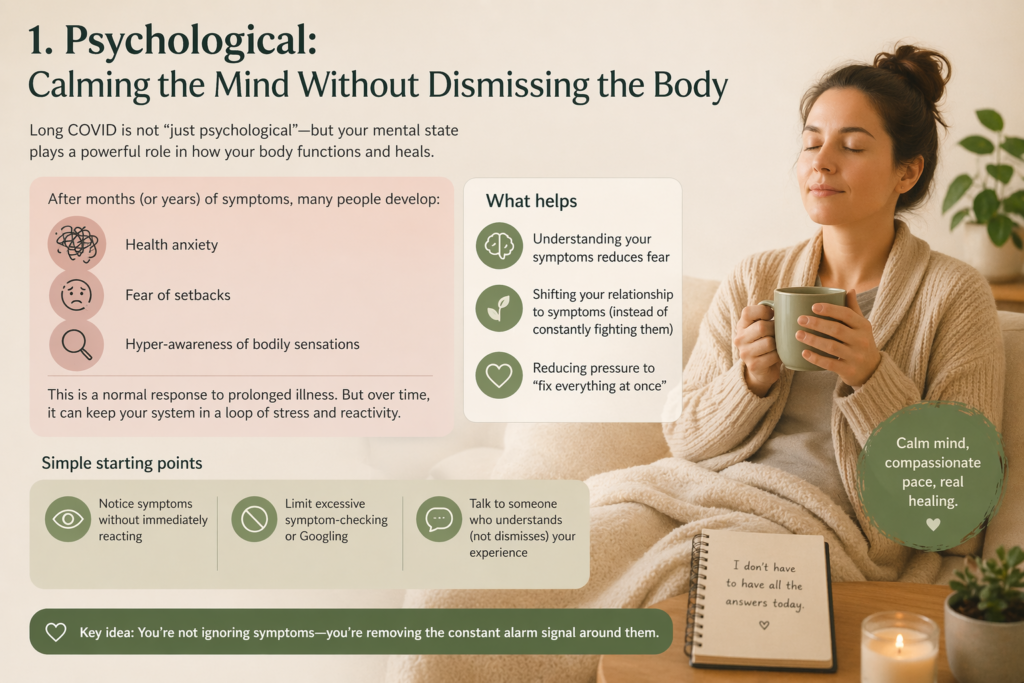
1. Psychological: Calming the Mind Without Dismissing the Body
Long COVID and Long-Jab is not “just psychological”—but your mental state plays a powerful role in how your body functions and heals.
After months (or years) of symptoms, many people develop:
- Health anxiety
- Fear of setbacks
- Hyper-awareness of bodily sensations
This is a normal response to prolonged illness. But over time, it can keep your system in a loop of stress and reactivity.
What helps
- Understanding your symptoms reduces fear
- Shifting your relationship to symptoms (instead of constantly fighting them)
- Reducing pressure to “fix everything at once”
Simple starting points
- Notice symptoms without immediately reacting
- Limit excessive symptom-checking or Googling
- Talk to someone who understands (not dismisses) your experience
Key idea: You’re not ignoring symptoms—you’re removing the constant alarm signal around them.
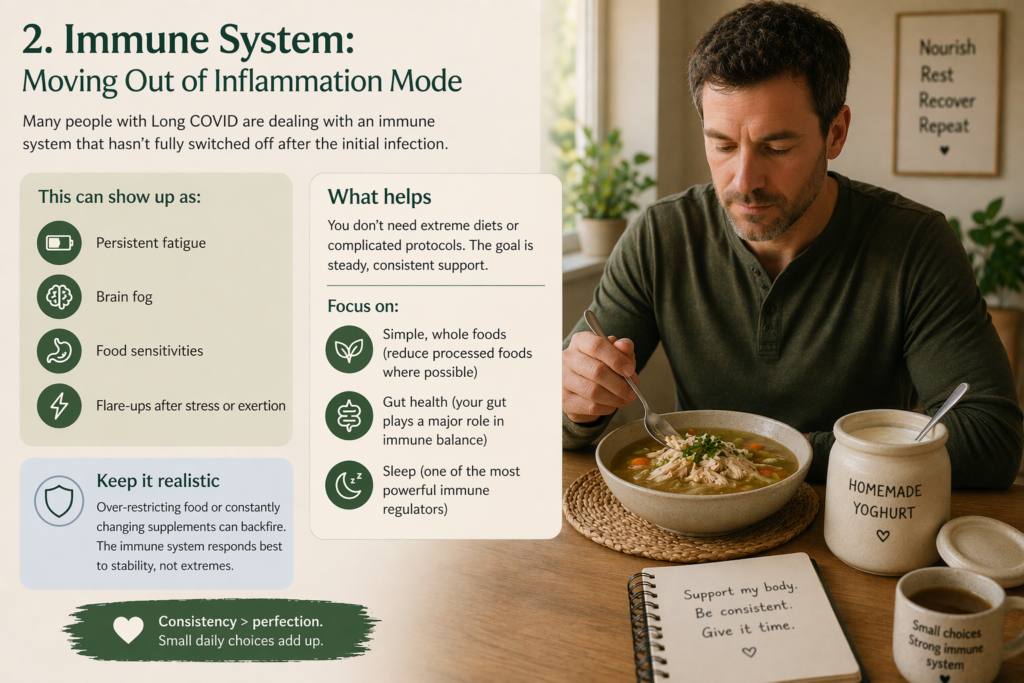
2. Immune System: Moving Out of Inflammation Mode
Many people with Long COVID or Long-Jab are dealing with an immune system that hasn’t fully switched off after the initial infection.
This can show up as:
- Persistent fatigue
- Brain fog
- Food sensitivities
- Flare-ups after stress or exertion
What helps
You don’t need extreme diets or complicated protocols. The goal is steady, consistent support.
Focus on:
- Simple, whole foods (reduce processed foods where possible)
- Gut health (your gut plays a major role in immune balance)
- Sleep (one of the most powerful immune regulators)
Keep it realistic
Over-restricting food or constantly changing supplements can backfire. The immune system responds best to stability, not extremes.
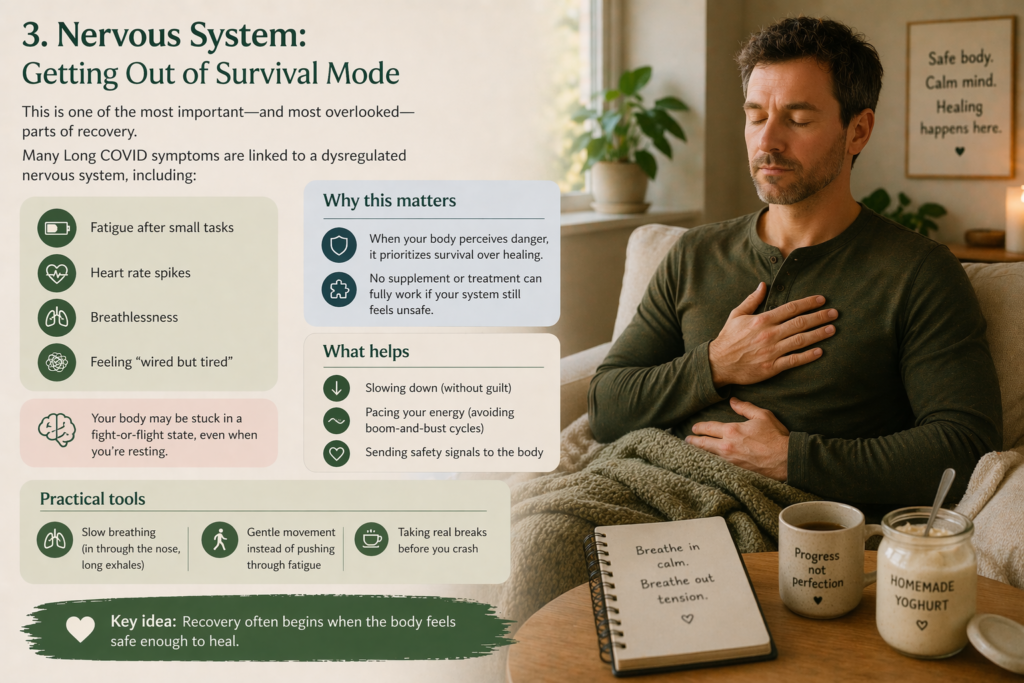
3. Nervous System: Getting Out of Survival Mode
This is one of the most important—and most overlooked—parts of recovery.
Many Long COVID and Long-Jab symptoms are linked to a dysregulated nervous system, including:
- Fatigue after small tasks
- Heart rate spikes
- Breathlessness
- Feeling “wired but tired”
Your body may be stuck in a fight-or-flight state, even when you’re resting.
Why this matters
When your body perceives danger, it prioritizes survival over healing.
No supplement or treatment can fully work if your system still feels unsafe.
What helps
- Slowing down (without guilt)
- Pacing your energy (avoiding boom-and-bust cycles)
- Sending safety signals to the body
Practical tools
- Slow breathing (in through the nose, long exhales)
- Gentle movement instead of pushing through fatigue
- Taking real breaks before you crash
Key idea: Recovery often begins when the body feels safe enough to heal.
4. Endocrine System: Stabilising Energy and Hormones
Your hormones—especially cortisol and thyroid function—play a major role in how you feel day to day.
With Long COVID and Long-Jab, this system can become disrupted, leading to:
- Poor sleep
- Energy crashes
- Mood swings
- Feeling exhausted but unable to rest
What helps
The goal here is rhythm and consistency.
Focus on:
- Regular sleep and wake times
- Morning light exposure (even 10–15 minutes helps)
- Reducing late-night stimulation (screens, stress, overthinking)
Gentle support
- Eat regularly (avoid long periods without food if it worsens symptoms)
- Keep activity levels consistent rather than extreme
Key idea: Your body thrives on predictable patterns—this helps reset hormonal balance over time.

How It All Connects
These four systems are deeply linked:
- Stress affects your immune system
- Immune activity affects your brain and mood
- Your nervous system controls both inflammation and hormones
- Hormones influence your energy, sleep, and resilience
That’s why quick fixes often don’t work.
Real recovery happens when multiple systems are supported at the same time.
What Recovery Actually Looks Like
Recovery from Long COVID and Long-Jab is rarely a straight line.
It often looks like:
- Small improvements over time
- Occasional setbacks (that become less severe)
- Gradually increasing tolerance to activity
What matters most is consistency, not intensity.
A Final Word
If you’re dealing with Long COVID or Long-Jab, you’re not alone—and you’re not imagining what’s happening in your body.
But you also don’t need to chase every new treatment or push yourself to exhaustion trying to “beat” it.
Start here:
- Calm the system
- Support the body
- Speak to someone who knows how to support recovery.
- Build slowly
Healing is possible—but it happens when your body is given the conditions to recover, not forced into it.
If you could use support, short online consultations can be booked in for personalized support and guidance.