Why the Gut Comes First in Complex Recovery
In conditions like SIBO (Small Intestinal Bacterial Overgrowth), Long COVID, and broader dysbiosis patterns, the gut is often not just a digestive organ — it becomes a central regulatory hub affecting:
- immune balance
- inflammation signalling
- energy metabolism
- nervous system stability
- food tolerance
When this system becomes disrupted, symptoms can extend far beyond digestion.
This is why increasing attention has been given to targeted microbial strategies — including the use of specific probiotic strains such as Lactobacillus reuteri (L. reuteri).
What Is L. reuteri?
Lactobacillus reuteri is a probiotic species naturally found in parts of the human gut and historically more prevalent in traditional microbiomes than in modern ones.
It has been studied for its role in:
- modulating immune responses
- producing antimicrobial compounds (like reuterin)
- supporting gut barrier function
- influencing inflammation signalling
- interacting with the gut–brain axis
However, in modern populations, levels of L. reuteri are thought to be significantly reduced — potentially due to diet, antibiotics, and microbiome disruption.
Dr. William Davis and the “Super Gut” Approach
Cardiologist Dr. William Davis, author of Super Gut, has popularised the idea that modern gut conditions (including SIBO, bloating, brain fog, and dysbiosis patterns) may be partly driven by loss of specific ancestral microbes.
In his work, he emphasises:
- restoration of missing beneficial strains
- reduction of small intestinal bacterial overgrowth (SIBO) patterns
- use of targeted, home-fermented probiotics rather than generic commercial products
One of his most well-known protocols involves cultivating high-dose L. reuteri yoghurt at home using specific starter strains.
He proposes that certain strains of L. reuteri may:
- help suppress undesirable gut microbes
- support gut lining integrity
- improve metabolic and inflammatory signalling
- contribute to improved energy and body composition in some individuals
These claims are based on a mix of research literature and clinical observation, but are still evolving and not universally established in mainstream gastroenterology.
What Is L. reuteri Yoghurt?
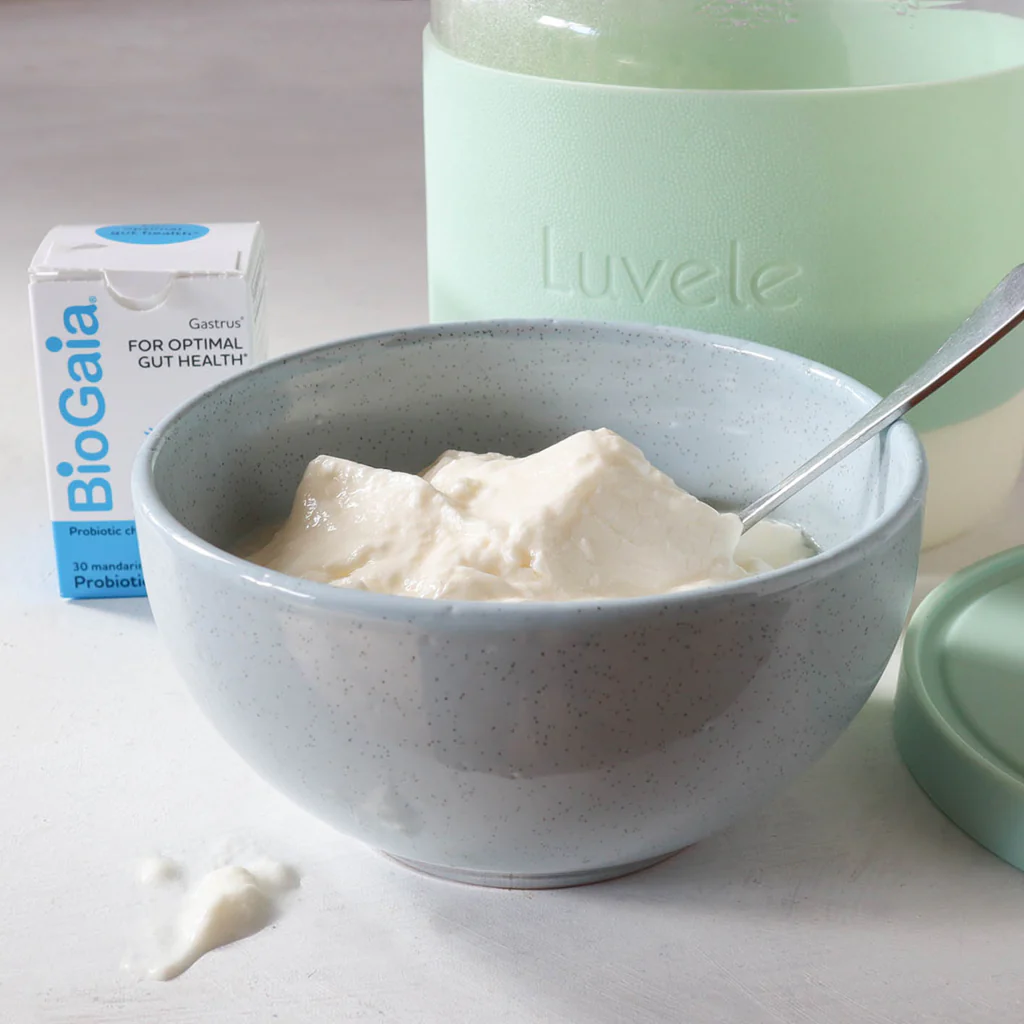
L. reuteri yoghurt is a home-fermented probiotic food created by incubating milk with specific probiotic strains of L. reuteri.
Unlike standard yoghurt, it is typically:
- fermented at lower temperatures for longer periods
- made with specific probiotic capsules or starter cultures
- designed to significantly increase bacterial concentration
Commonly used strains include:
- L. reuteri DSM 17938
- L. reuteri ATCC PTA 6475
These strains are often used together in DIY fermentation protocols.
How It Is Thought to Help SIBO and Dysbiosis
From a systems perspective, L. reuteri yoghurt is not considered a “cure” for SIBO, but is used as a microbial reconditioning strategy.
Potential mechanisms discussed in research and functional medicine include:
1. Competitive exclusion
Beneficial bacteria may help suppress overgrowth of less desirable organisms by competing for resources and producing antimicrobial compounds.
2. Gut barrier support
A healthier microbial environment may support tighter intestinal barrier function, reducing permeability-related symptoms.
3. Immune modulation
L. reuteri may influence immune signalling in the gut, helping shift the system away from chronic low-grade inflammation.
4. Gut–brain axis effects
Changes in gut flora can influence vagus nerve signalling, stress response, and neurological symptoms often reported in dysbiosis states.
SIBO Context: Why This Is Complex
SIBO is not simply “low good bacteria” or “high bad bacteria.”
It is often associated with:
- impaired gut motility
- altered migrating motor complex (MMC) function
- prior infection or inflammation
- microbiome imbalance in both small and large intestine
Because of this complexity, approaches like L. reuteri yoghurt are typically considered supportive rather than standalone treatments.
In some cases, introducing probiotics too early or in the wrong context may aggravate symptoms — especially in highly sensitive individuals.
Homemade Fermentation: Why People Use It
Dr. William Davis and others in the functional microbiome space argue that commercial probiotics may be:
- too low in bacterial concentration
- too transient in gut survival
- lacking strain specificity
Homemade fermentation is used to potentially achieve:
- higher colony counts
- fresher, active cultures
- more targeted strain delivery
However, this approach requires careful hygiene, correct temperatures, and individual tolerance awareness.
Important Considerations (Especially in SIBO or Long COVID-Type States)
While some people report improvements, it is important to be cautious:
- Some individuals with SIBO may initially worsen with fermentation products
- Histamine sensitivity can be an issue for some people
- Introducing new bacteria into a dysregulated gut can temporarily shift symptoms
- Response is highly individual and not predictable
This is not a “one-size-fits-all” intervention.
A Systems View of Gut Repair
From a broader recovery perspective, L. reuteri yoghurt fits into a larger framework:
- reduce inflammatory load
- restore microbial diversity gradually
- support motility and digestion
- rebalance immune signalling
- stabilise nervous system–gut communication
It is one tool among many, not a standalone solution.
Closing Perspective
The growing interest in L. reuteri and gut-focused interventions reflects a larger shift in how chronic conditions are understood.
Rather than viewing SIBO, dysbiosis, or post-viral symptoms as isolated gut problems, they are increasingly seen as part of a multi-system imbalance involving the microbiome, immune system, and nervous system together.
L. reuteri yoghurt, as described by Dr. William Davis and others in the functional microbiome space, represents an attempt to reintroduce specific missing microbial functions into a disrupted system.
For some, it may be a supportive part of recovery. For others, it may need to be introduced more cautiously or not at all.
As with all complex gut interventions, the guiding principle is not intensity — but stability, tolerance, and gradual rebuilding of balance.