
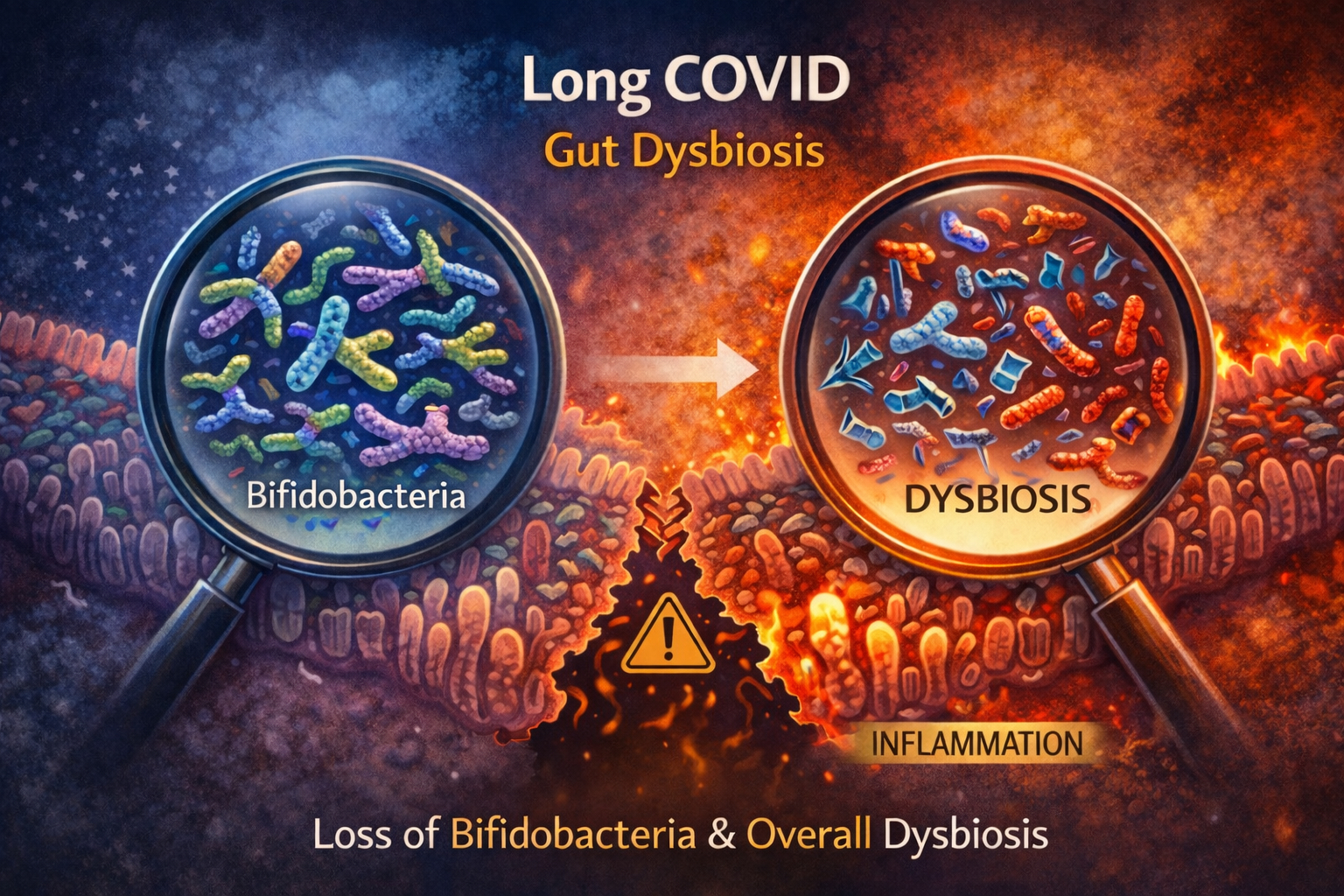
Why the Gut Became Part of the Long COVID Conversation
In recent years, research and patient experiences have increasingly pointed to the gut microbiome as an important part of Long COVID and post-viral illness.
Many people experiencing Long COVID-type symptoms describe changes that go far beyond respiratory issues — including fatigue, brain fog, nervous system sensitivity, food reactions, and unpredictable energy patterns.
One emerging theme is gut dysbiosis, a state where the balance of gut bacteria is disrupted.
In particular, attention has been drawn to reductions in beneficial bacteria such as Bifidobacteria, which play a key role in immune regulation, gut integrity, and nervous system signalling.
While this area is still evolving scientifically, it offers a useful framework for understanding one of the possible layers of dysfunction in complex post-viral illness.
What Is Dysbiosis?
Dysbiosis refers to an imbalance in the gut microbiome — the ecosystem of bacteria that lives in the digestive tract.
In a balanced state, the microbiome supports:
- Digestion and nutrient absorption
- Immune system regulation
- Production of short-chain fatty acids (important for gut and brain health)
- Protection of the gut lining
- Communication with the nervous system via the gut–brain axis
In dysbiosis, this balance shifts. Beneficial species may decrease, while less helpful or opportunistic microbes may increase.
This doesn’t mean the gut is “infected” — it means the ecosystem has lost stability.
The Role of Bifidobacteria
Among the most important beneficial bacteria in the human gut are Bifidobacteria.
These organisms are especially important for:
- Maintaining gut barrier integrity
- Supporting immune tolerance (preventing overreactions)
- Producing metabolites that support energy metabolism
- Modulating inflammation
- Supporting gut–brain communication
In early life, Bifidobacteria are dominant in the microbiome. In healthy adults, they remain a key stabilising group.
When levels become significantly reduced — sometimes described in research and clinical discussions as a “wipeout” or severe depletion — the system may become more reactive and less resilient.
How This May Relate to Long COVID
In Long COVID and similar post-viral or post-vaccination syndromes, several overlapping mechanisms are being explored. One of them is microbiome disruption.
Potential contributing factors include:
- Immune system activation during acute illness
- Inflammatory signalling affecting gut ecology
- Changes in diet, stress, or medications during illness
- Disruption of the gut–brain axis
- Viral effects on gut-associated immune tissue
In this context, reduced Bifidobacteria and broader dysbiosis may contribute to:
1. Immune dysregulation
A less stable microbiome may affect how the immune system distinguishes between threat and safety, potentially contributing to heightened or inconsistent immune responses.
2. Increased inflammation
Loss of beneficial bacteria can reduce production of anti-inflammatory metabolites, potentially contributing to a more inflamed internal environment.
3. Gut–brain axis disruption
The gut communicates directly with the brain via neural, immune, and metabolic pathways. Dysbiosis may influence:
- anxiety levels
- stress sensitivity
- sleep quality
- cognitive function (“brain fog”)
4. Energy metabolism changes
Microbial imbalance may affect nutrient extraction and mitochondrial support pathways, potentially influencing fatigue and energy instability.
Why This Matters in Complex Recovery
One of the key challenges in Long COVID-type conditions is that symptoms rarely come from a single source.
Instead, multiple systems appear to interact:
- Nervous system dysregulation
- Immune system instability
- Endocrine rhythm disruption
- Gut microbiome imbalance
The gut is increasingly viewed not as an isolated system, but as a central communication hub between these systems.
When microbiome balance is disrupted — especially involving key stabilising species like Bifidobacteria — it may amplify instability elsewhere in the body.
A Systems View: Not One Cause, But a Network
It is important to approach this topic carefully.
A reduction in Bifidobacteria is not likely to be the sole cause of Long COVID or post-viral illness. Instead, it may be part of a wider network of dysregulation.
In this view, symptoms are not driven by one problem, but by:
- Feedback loops between immune and nervous systems
- Altered gut–brain signalling
- Changes in energy regulation and circadian rhythm
- Microbiome shifts that reinforce systemic sensitivity
This helps explain why recovery is often non-linear and why symptoms can fluctuate in waves.
What People Commonly Explore (Supportive Approaches)
While research is still developing, people in recovery often explore supportive strategies aimed at restoring microbial balance and gut resilience, such as:
- Increasing dietary fibre diversity (plant variety)
- Prebiotic foods that support Bifidobacteria growth
- Targeted probiotics (in some cases, strain-specific approaches are discussed in research)
- Stress regulation and nervous system calming (important for gut signalling)
- Consistent sleep and circadian rhythm support
- Gradual pacing to reduce systemic stress load
Importantly, responses can vary significantly between individuals, especially in sensitive or reactive states.
The Bigger Picture
From a systems perspective, the gut microbiome is not separate from the rest of the body’s recovery process.
It is part of a larger loop that includes:
- Immune signalling
- Nervous system regulation
- Hormonal balance
- Energy production
- Psychological state
When one part of this system becomes destabilised, it can influence all the others.
This is why recovery often requires a multi-layered approach rather than a single intervention.
Closing
The relationship between Long COVID, dysbiosis, and Bifidobacteria loss is still being actively researched, but it offers a useful framework for understanding why symptoms can feel so widespread and interconnected.
For many people, recovery is not just about addressing one system — it is about gradually restoring balance across several overlapping systems at once.
And in that process, the gut may play a far more central role than previously understood.